
Registering inherited property records the heirs’ entitlement in the Turkish land register. Inheritance generally passes on death, while a land registry application updates the registered ownership. Where several heirs inherit, registration does not award the property solely to the heir who submits the application. Acquiring an inheritance, registering it and dividing the estate are separate stages. Turkish Civil Code Articles 599, 640 and 705.
This guide covers the general procedure for registered land and buildings in Turkey. Wills, foreign documents, agricultural land, minors or heirs under guardianship may require additional rules and documents to be considered.
Sources checked:
Why register property if inheritance passes on death?
The Turkish Civil Code provides for heirs to acquire an inheritance as a whole on death. Inheritance is an exception to the general rule that ownership of immovable property is acquired by registration. However, the owner’s ability to carry out transactions disposing of that ownership depends on its entry in the land register. Obtaining a certificate of inheritance therefore does not itself update the property record. Civil Code Articles 598-599 and 705.
Saim İncekaş on inherited ownership before land registration distinguishes acquiring ownership from the registration required for later dealings (in Turkish). This explains why acquiring an inheritance does not remove the need to update the land register.
An inheritance registration application does not divide property values between heirs or resolve a family dispute over allocation. The initial task is to connect the correct inheritance certificate with the correct property record.
Can one heir apply for registration?
One heir can apply to register inherited property under joint estate ownership. TKGM’s current guidance provides for an heir to submit the required documents through Web Tapu. The process records the entitled heirs, rather than making the applicant the sole owner. TKGM guidance on inheritance registration.
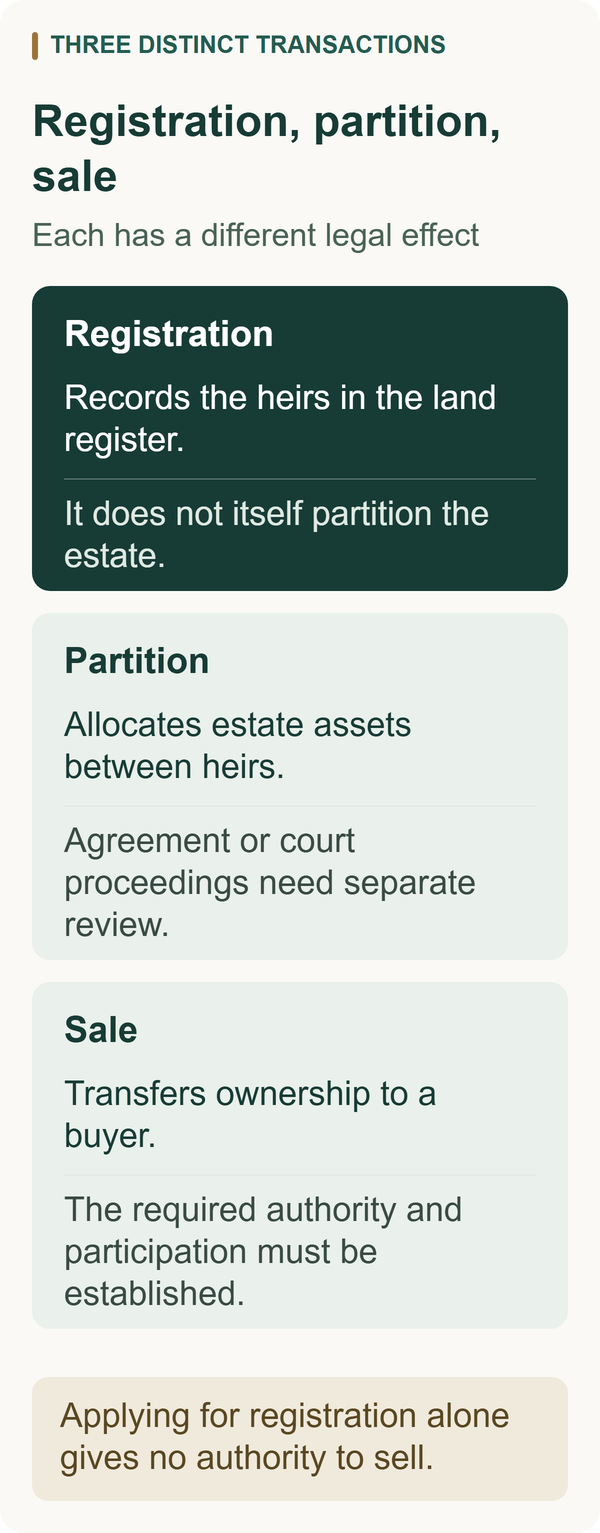
The right to apply does not authorize that heir to transfer another heir’s interest or sell the entire property. Lawyer Ahmet Emre Çimen’s distinction between registration and later transactions also separates a single heir’s application from the participation required for partition or sale (in Turkish). Civil Code Article 640 governs dealings with estate rights.
A person acting through a representative needs the relevant authority document. Check whether it covers registration, partition, sale or only some of these acts. Authority to submit an application does not automatically cover every later transaction.
Which documents are required?
TKGM’s basic list includes:
- Identity documents: For the relevant persons and any representatives. A foreign national’s national identity document or passport is considered.
- Certificate of inheritance: The original or a certified copy issued by a civil court of peace or a notary.
- Authority document: Where there is representation, an appropriate power of attorney, guardianship decision or other relevant document.
- Compulsory earthquake insurance: A DASK policy for buildings covered by the compulsory scheme. Do not assume that every undeveloped plot or field requires DASK.
Prepare the province, district, block, parcel and, where applicable, independent unit details for each property. Check that the persons identified in the inheritance certificate, property records and identity documents match. Our certificate of inheritance guide explains how the certificate is obtained.
Lawyer Eyüpcan Çelik’s advice on preparing an inheritance registration file highlights keeping organized property details and checking the names and property identifiers on documents received (in Turkish). This is a useful way to identify missing or inconsistent information before applying.
How do Web Tapu and the land registry stages work?
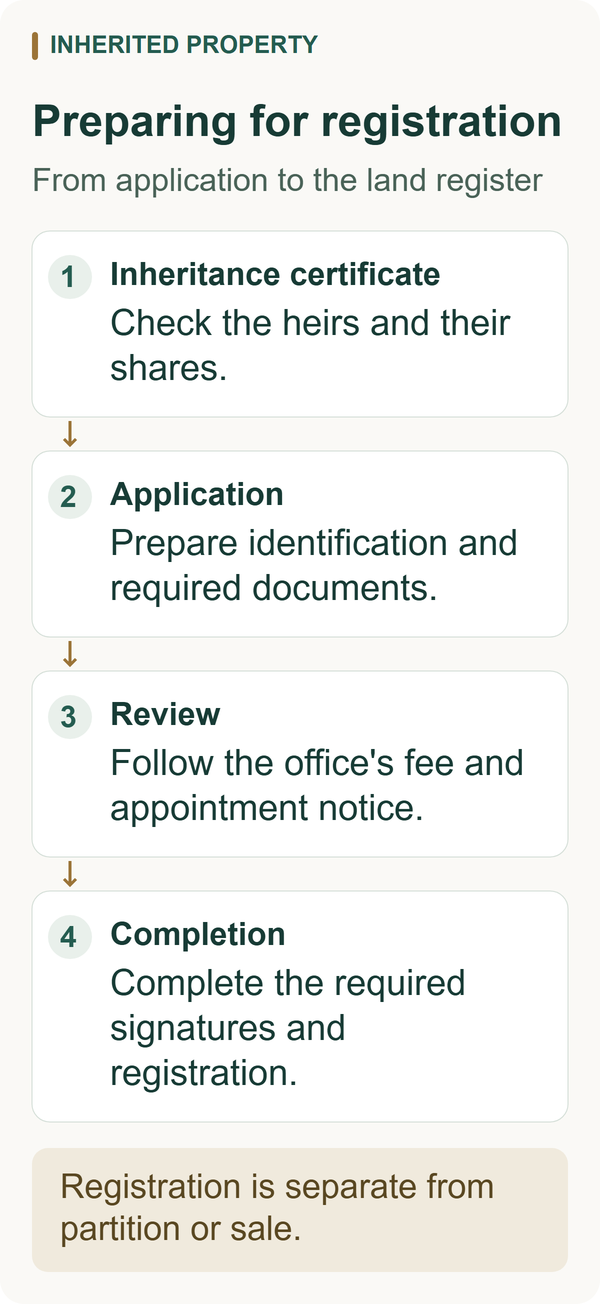
- Prepare the inheritance and property details. Identify whether the intended transaction is registration alone or also includes a later sale or partition.
- Apply through the official Web Tapu service. Submit the information and documents requested for the relevant transaction. The official entry point is TKGM Web Tapu.
- Follow the land registry’s review and notifications. Provide any requested corrections for missing or inconsistent documentation.
- Follow the notified service fee and appointment arrangements. TKGM explains that the revolving fund service fee is notified by SMS and the signature stage follows payment at the appointment given.
- Check the resulting registration. Confirm that the relevant properties and entitled persons are recorded correctly, and retain the application and completion documents.
Applying online does not mean that every case is completed entirely online. The standard procedure described by TKGM includes a signature stage at the land registry. Follow the registry’s instructions for the transaction and the form of representation involved. TKGM application guidance.
Can inherited property be registered before inheritance tax is paid?
Registration can proceed without waiting for the assessment of inheritance and transfer tax. Article 19 of Law No. 7338 provides for the registration result to be reported to the relevant tax office within 15 days. This registry notification should not be treated as replacing the heir’s obligation to submit a tax return. Law No. 7338, Articles 7, 9 and 19.
A later transfer or creation of a right in rem is different. The general rule under the same provision is that the inherited property cannot be transferred, and a right in rem cannot be created over it, until the inheritance and transfer tax attributable to that property has been paid in full. Being entered as an heir and being ready to sell or mortgage the property are therefore different stages.
The law also permits authorization to transfer some or all of the property where suitable security of the prescribed type under Law No. 6183 is provided for the assessed tax. This does not remove the tax obligation or apply automatically to every application. The security and permission requirements need separate consideration with the tax authority. Law No. 7338, Article 19, final paragraph.
The tax return deadline depends on where the death occurred and where the taxpayer is located. For example, where the death occurs in Turkey and the taxpayer is in Turkey, the period is four months following the death. It does not start with the land registry appointment. Do not apply that four-month period indiscriminately to other country combinations. Law No. 7338, Article 9.
The registry’s revolving fund service fee, the cost of obtaining an inheritance certificate and inheritance tax are separate items. Check the amount notified for the actual transaction and the required documents, instead of assuming a fixed overall price or guaranteed completion date.
How do registration, estate partition and sale differ?
Registration records the heirs’ entitlement in the land register. Partition allocates the estate assets between heirs. Sale is a separate transaction transferring a property or transferable ownership share to a buyer. Completing registration does not automatically complete either of the other transactions.
For example, where two siblings inherit an apartment, one sibling’s application does not award the apartment solely to that sibling. Joint estate ownership is the general position pending partition. Allocating the apartment to one sibling requires the appropriate separate partition or transfer process. Converting joint ownership into ownership in defined shares is also different from physically dividing the property. TKGM describes an application by all owners and, where the requirements are met, notification or court procedures for that conversion. Civil Code Articles 640, 642 and 644; TKGM guidance on joint ownership.
See our estate partition guide for agreements and disputes, and the inheritance shares guide for the heirs’ entitlements.
What should you check before applying?
- Do the persons in the inheritance certificate match the property and identity records?
- Is the application for registration alone, or is a sale or partition also planned?
- Does the representative’s authority cover the intended transaction?
- Is the property covered by compulsory earthquake insurance, and is the required policy ready?
- Is the tax return deadline being tracked separately?
- Is there a will, foreign document, renunciation or dispute over heirship requiring additional review?
If renunciation of inheritance is being considered, examine the renunciation deadline and the consequences of the heir’s conduct before acting. This guide does not decide whether a particular act constitutes acceptance in an individual case.
Common questions
Does the land register update automatically on death?
Acquiring an inheritance and updating the register are different. An application and registration process are needed to record the entitled heirs.
Is an inheritance certificate enough to sell the property?
No. Registration, the ownership structure, the participation or representation of the entitled persons and the tax requirements must also be considered.
Can a foreign inheritance document be used directly?
Do not assume direct acceptance. TKGM points to Turkish court approval for inheritance documents issued by foreign courts. Check the requirements for the foreign document and representation before applying.
Official sources
- Turkish Civil Code, Law No. 4721: Articles 598-599, 640, 642, 644 and 705 (Turkish).
- General Directorate of Land Registry and Cadastre frequently asked questions: inheritance registration documents and procedure, tax clearance, DASK, service fees and joint ownership (Turkish).
- Inheritance and Transfer Tax Law No. 7338: Articles 7, 9 and 19 (Turkish).
This text provides general information. Required documents and legal consequences depend on the circumstances of the individual case.