
A lifetime transfer of registered land may be challenged as muris muvazaası when the deceased disguised an intended gift as a sale to deprive an heir of inheritance rights. A transfer to a relative or a low recorded sale price does not establish the claim by itself. The parties’ real intention, their agreement and the evidence must be considered together. Court of Cassation General Assembly of Civil Chambers, 2022/1101 E., 2022/1941 K.
This guide explains the general framework under Turkish law. The transfer and death dates, land register history, relief sought and any international elements require separate assessment.
Sources checked:
Which transfers fall within muris muvazaası?
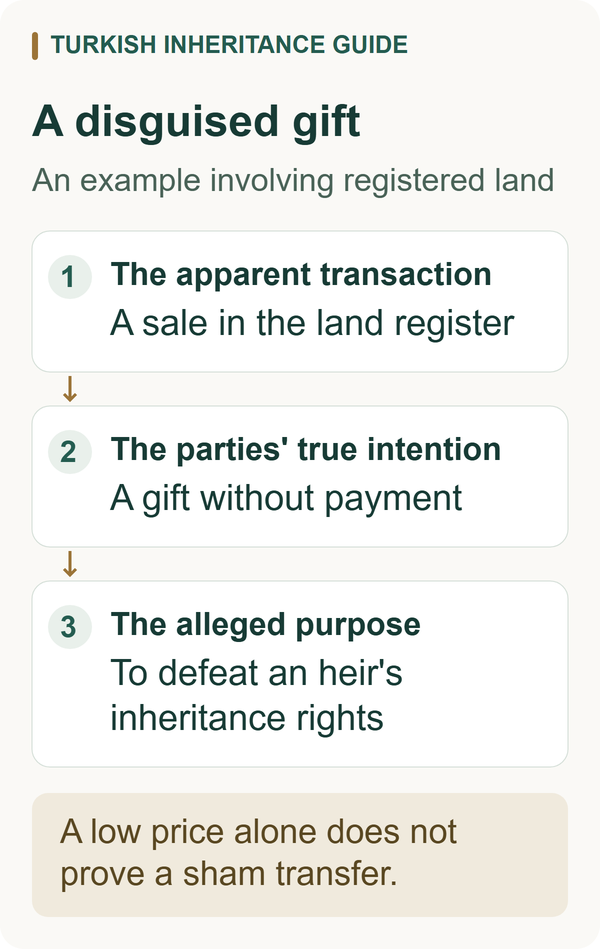
In the classic example, the deceased formally sells registered land while both parties actually intend a gift. The purpose is to deprive an heir of inheritance rights. The apparent sale does not reflect their true agreement, while the concealed gift lacks the required official form. These defects provide the basis for challenging the transfer. Code of Obligations, Articles 19 and 237; Civil Code, Article 706; Land Registry Law, Article 26.
The scope of the unification judgment of 1 April 1974, No. 1/2, is explained in the General Assembly’s 2022 judgment. A concealed gift presented as a lifetime maintenance agreement may also be investigated. A genuine care arrangement, a genuine sale or a distribution involving benefits to other heirs does not automatically satisfy the doctrine.
The same route does not automatically apply to unregistered land, money or other assets. The Court of Cassation judgment of 27 March 2025 addresses the limits of the 1974 ruling where land was unregistered at the time of transfer. The asset’s legal status at that time must be established.
Who can bring a claim, and when?
Succession opens on death. An heir whose inheritance rights have been infringed brings this claim after the deceased’s death. The expectation of becoming an heir while the owner is alive does not, by itself, establish a right to bring this inheritance-based action. Civil Code, Articles 575 and 599; judgment of 20 March 2025.
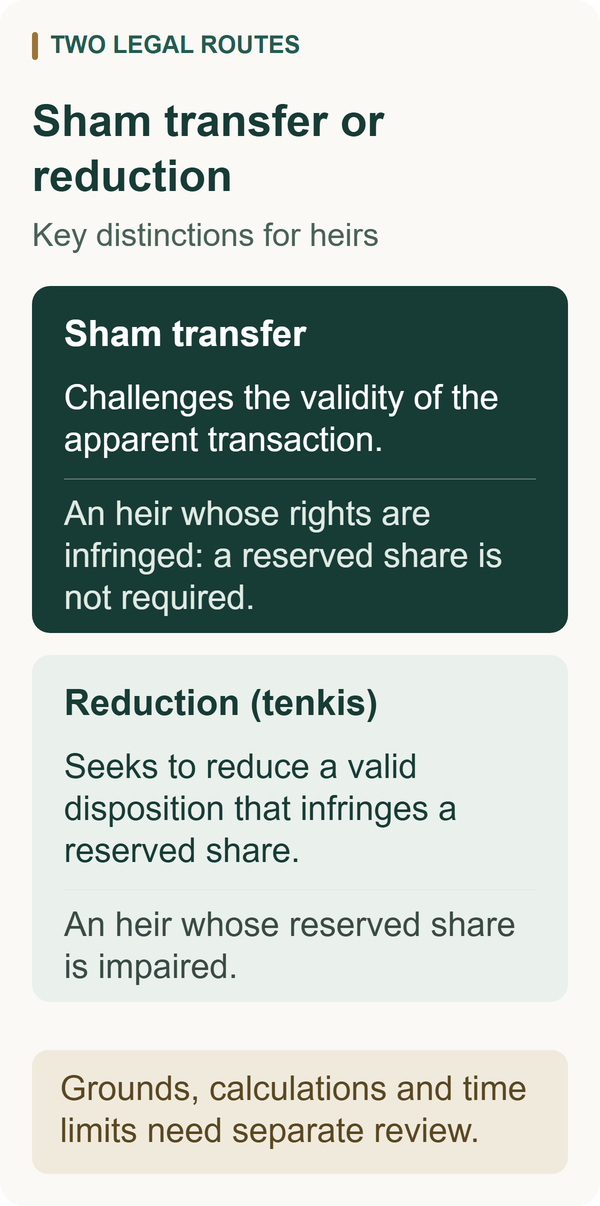
A reserved share is not a prerequisite. A person who qualifies as an heir and whose inheritance rights have been infringed may rely on muris muvazaası even without a reserved entitlement. An heir may seek cancellation and registration in proportion to their own inheritance share. Seeking restoration of the whole property to the estate raises separate participation and representation issues. An action by one heir does not invariably determine title for every heir. General Assembly, 2022/1101 E., 2022/1941 K.; First Civil Chamber, 2022/2810 E., 2024/990 K.; Civil Code, Article 640.
See our guides to certificates of inheritance and legal heirs and inheritance shares for these preliminary questions.
How is the alleged sham transfer proved?
The claimant alleging the sham generally bears the burden of proof. Heirs asserting their own inheritance rights as third parties to the transaction may use any legally admissible evidence, including witnesses. A recorded sale does not remove the need to investigate the real intention; an allegation alone is also insufficient. Code of Civil Procedure, Articles 189-190, 194 and 203(1)(d); paragraphs 40-44 of the General Assembly judgment.
- The land records, official transfer instrument and subsequent transfers.
- The price, payment records and evidence of the property’s actual value at the transfer date.
- Facts showing the deceased’s reason for selling and the buyer’s ability to pay.
- Family and care relationships, use of the property and benefits given to other heirs.
- Witnesses with direct knowledge of specific events, and an explanation of which allegation each document supports.
Lawyer Murat Adar’s discussion of sham inheritance transfers considers the chain of transfers and payment trail in their wider factual context. Its distinction between a low price and conclusive proof is useful when organising a file (in Turkish).
How does this differ from a reserved-share reduction claim?
Muris muvazaası concerns the invalidity of the apparent transaction. Reduction concerns bringing a benefit that infringes a reserved share within the legally permitted limits. An openly recorded gift is different from a gift disguised as a sale. The judgment of 8 February 2024 illustrates that, where an open gift does not satisfy the sham-transfer doctrine, a separately advanced reduction claim still requires examination.
Lawyer Alper Germen’s article on reserved shares and reduction explains the second remedy’s focus on protected inheritance entitlements (in Turkish). Assessing a valid benefit for reduction requires separate examination of the eligible heir, calculation and time limits. Our reserved-share and reduction guide explains these issues.
For a comparison of who can bring the two claims, Saim İncekaş on sham transfers and reserved-share reduction discusses the distinction between validity and reserved entitlement (in Turkish). The key point here is that standing under muris muvazaası is not confined to reserved-share heirs.
Deception practised on the deceased, lack of capacity at the transaction date, and equalisation of valid benefits when dividing an estate can involve different legal grounds. Describing an event as “concealing inheritance assets” does not identify the appropriate claim or its time limit. Code of Obligations, Article 36; Civil Code, Articles 13, 15 and 669.
Why check time limits and cadastral history?
The general approach is that a title cancellation and registration claim based on muris muvazaası is not subject to a limitation or forfeiture period. This should not be read as permission to wait indefinitely in every property dispute or for every form of relief. Reduction, deception and claims on other legal grounds have different time rules. General Assembly, 2017/1251 E., 2020/673 K.; Civil Code, Article 571; Code of Obligations, Article 39.
Cadastral registration is an important exception. Under the statutory conditions, objections and actions based on legal grounds preceding the cadastral survey may be subject to a ten-year forfeiture period starting when the cadastral record becomes final. This is not a general inheritance period running from death. In the cited case, the deceased had died before the cadastral determination; the sequence of death and cadastral dates also matters. Article 12(3) of Law No. 3402 and the judgment of 20 March 2025 applying it to a sham-transfer allegation show why the land register and cadastral history must be examined together.
What if the property has been sold again?
The current registered owner and the complete chain of transfers must be identified. A third party acquiring a right in rem in good faith in reliance on the land register may be protected. A person who knew or should have known of the defective registration cannot rely on the same protection. Alleging a sham in the first transfer does not mean that every subsequent buyer’s title must be cancelled. Civil Code, Articles 1023-1025.
Which court, and what relief?
The generally competent court is the civil court of first instance, asliye hukuk mahkemesi. For cancellation and registration affecting rights in land, the court where the property is located has exclusive territorial jurisdiction. Multiple properties and combined claims require separate assessment. Code of Civil Procedure, Articles 2 and 12.
Preparation involves the death and transfer dates, certificate of inheritance, property details, current owner, share claimed and supporting evidence. If another transfer could make obtaining the claimed right substantially harder, the conditions for an interim injunction may also need examination; an injunction is not automatic. Code of Civil Procedure, Articles 119, 194 and 389-390. This working list does not make the same documents mandatory in every case.
Official sources
- Turkish Civil Code, Law No. 4721 (in Turkish): Articles 13, 15, 560, 571, 575, 599, 640, 669, 706 and 1023-1025.
- Code of Obligations, Law No. 6098 (in Turkish): Articles 19, 36, 39 and 237.
- Code of Civil Procedure, Law No. 6100 (in Turkish): Articles 2, 12, 119, 189-190, 194, 203(1)(d) and 389-390.
- Land Registry Law, No. 2644 (in Turkish): Article 26.
- Cadastre Law, No. 3402 (in Turkish): Article 12(3).
- General Assembly, 2022/1101 E., 2022/1941 K., 28 December 2022 (in Turkish): scope, reproduction of the 1974 ruling and evidence.
- General Assembly, 2017/1251 E., 2020/673 K. (in Turkish): time and evidence in sham-transfer claims.
- First Civil Chamber, 2022/2810 E., 2024/990 K., 8 February 2024 (in Turkish): open gifts and reduction.
- First Civil Chamber, 2025/1345 E., 2025/1713 K., 27 March 2025 (in Turkish): transfers of unregistered land.
- First Civil Chamber, 2024/1262 E., 2025/1538 K., 20 March 2025 (in Turkish): pre-survey grounds and the ten-year period.